
Service disconnects for non-payment begin on the 5th day of each month. If your bill is past due and you choose to utilize the online payment portal, your bill must be paid on the 4th day of the month to prevent disconnection.
Water Rates
| MONTHLY USAGE (Gallons) | RATE |
| Availability of Service Charge (0 gallons) | $33.00 |
| First 2,000 gallons | $8.50/1,000 gallons |
| Next 4,000 gallons | $12.00/1,000 gallons |
| Next 14,000 gallons | $13.00/1,000 gallons |
| Greater than 20,000 gallons | $14.00/1,000 gallons |
Sewer Rates
| MONTHLY USAGE (Gallons) | RATE |
| Availability of Service Charge (0 gallons) | $30.00 |
| First 2,000 gallons | $2.50 |
| Next 3,000 gallons | $9.25 |
| Next 15,000 Gallons | $9.00 |
| Greater than 20,000 gallons | $15.00 |
PLATEAU UTILITY DISTRICT RECOMMENDS THE INSTALLATION OF A THERMAL EXPANSION TANK ON YOUR HOME or BUSINESS PLUMBING SYSTEM.
What Is Thermal Expansion?
…and what can I do about it?
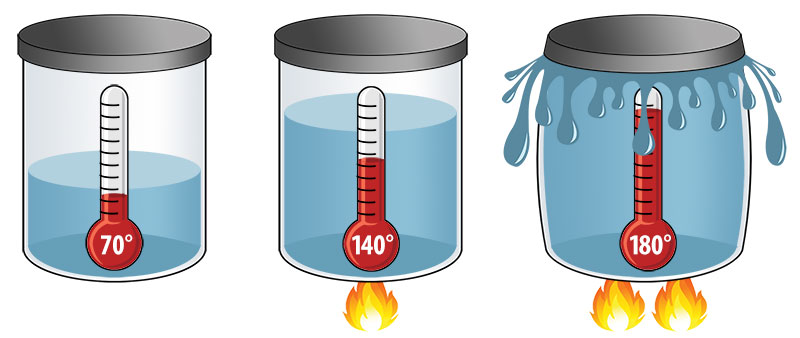
Thermal expansion is among the more serious of plumbing concerns, but one that many homeowners know little about.
What is Thermal Expansion?
Water doesn’t compress very much at all when subjected to pressure. And when heated, it expands in volume: the contents of a 40 gallon water tank can expand by half a gallon or more when heated! Neither of these properties bode well for closed plumbing systems.
If your home has a Pressure Reducing Valve (PRV), backflow prevention valve, recirculating pump with check valve, or anything else that prevents backflow of water installed, its plumbing system is considered “closed”. Plateau Utility District exclusively uses meter yokes with an integral check valve; thus effectively all of our customers have a closed plumbing system within their homes and businesses. A closed system is one in which potable water has no way to exit a home’s plumbing (in an open system, water inside plumbing can be forced back into the city water main through the supply line).
When heated water expands in a closed system, that additional volume has nowhere to go if fixtures aren’t being used: the PRV, backflow preventer, or check valve blocks the only other path of exit. This is a very good thing should backflow from your home threaten to contaminate the water supply, but a very bad thing for fixtures, pipes and water heater if precautions aren’t taken.
The pressure added to a closed system by thermal expansion can wear out seals, damage solenoid valves (like those found on washing machines, dishwashers) and even rupture pipe. Water heaters can find their lives severely shortened thanks to the added stress. In extreme cases, increased pressure in a gas or propane powered water heater can cause the flue inside to collapse, creating a carbon monoxide leak.
Ways to Deal With Thermal Expansion
Universal Plumbing Code requires that a thermal expansion device be installed whenever a PRV or backflow prevention is present. This usually comes in the form of an expansion tank that connects to the water heater, accommodating volume increases. Other options include valves with discharge outlets that simply drain whatever the system can’t hold, and special toilet fill valves that drain excess volume into the toilet tank.
Did You Know? A dripping Temperature and Pressure Relief (T&P) Valve on the water heater is an indicator of a potential thermal expansion problem. This is the valve with the small handle or lever that automatically opens when either the temperature or pressure inside the heater tank exceed a set limit (usually 150psi/210°F). These are emergency valves, and are not meant to operate regularly. When one of them leaks, the first step is usually to replace the valve. If the leaking continues, there’s a problem.
The tried and true way to deal with thermal expansion is with expansion tanks. Installed on the supply line, these tanks feature a rubber bladder or diaphragm that separates an air chamber from the rest of the tank. Air is pumped in to match the pressure of the water supply. When water expands, instead of building pressure in the confines of the water heater or plumbing, it enters the expansion tank, compressing the air. Once expansion has stopped and there’s room, the compressed air pushes the water back into the supply.
Expansion tanks must be pressurized correctly in order to function properly. It’s always best to follow the manufacturer’s instructions, which usually call for the air pressure to match the supply pressure (you can measure this on a spigot using a water pressure gauge). If the pressure is set too low, water will too easily enter the tank, which is not designed for such regular usage. Set too high, and water has a more difficult time getting in, defeating the tank’s purpose. You can verify the tank’s pressure using a standard tire air gauge.
If your supply pressure is above 80 psi, most manufacturers require that a PRV be installed before the expansion tank. This is also a good idea to save your plumbing from unnecessary stress.
Expansion tanks usually have a 150 psi maximum pressure.
Expansion tanks are sized based on the water heater’s capacity and the incoming supply pressure. Be sure that you have accurate numbers for both before purchasing.
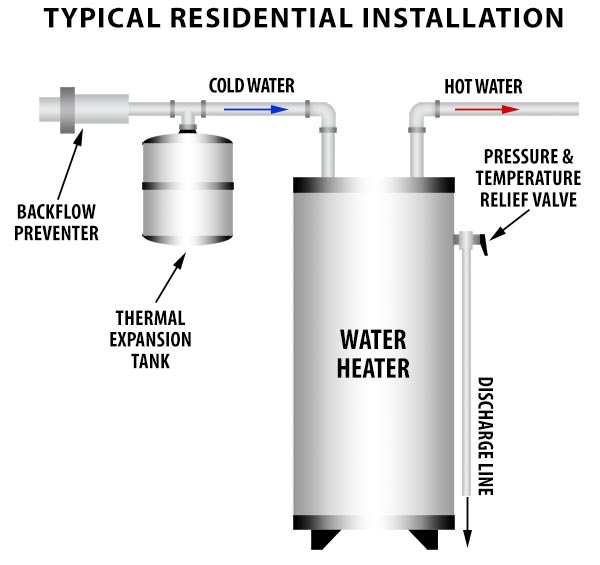
Expansion tanks should be installed on the incoming cold water supply line, before the water heater. Although many tanks can be installed in any orientation, they will perform best and last longer when installed on a horizontal run, with the tank inlet pointing down (ensuring that water makes its way in only when necessary, and drains from the tank easily).
A cursory check of the tank’s condition can be done anytime the water heater isn’t heating by tapping its exterior with knuckles or a coin: it should sound like a (mostly) hollow metal tank. If you hear more of a thud, the tank may be full of water. You can confirm a waterlogged tank by removing the cap protecting the Schrader air valve (the same kind found on car and bike tires) and pressing down on the pin. As with your tires, air should come out. If water comes out, the rubber has deteriorated and a new tank is needed. If nothing happens, the tank may not have enough air in it: use a bike pump or air compressor to re-pressurize the chamber, following manufacturer instructions.
Quick Tip: Expansion tanks should be inspected annually. Once installed, the only way to get an accurate reading on the expansion tank’s air pressure is to shut off the water supply and relieve system pressure by opening a faucet before measuring. Since your water heater should also be on an annual maintenance routine, it makes sense to deal with both at the same time.
If you already have an expansion tank installed, great! If you don’t know whether your plumbing system is open or closed, find out! While your home may have a device regulating water pressure, or safeguards against contaminating the water supply, it still may be vulnerable to the damaging pressure of thermally-expanded water.
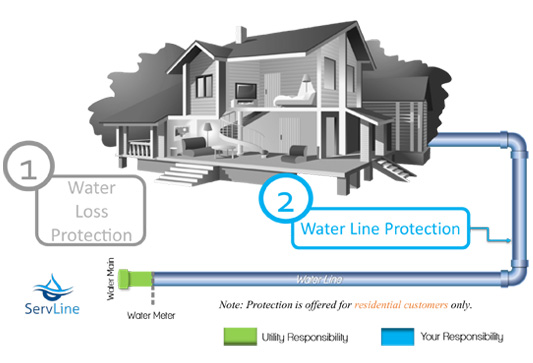
HAVE A HIGH WATER BILL?……HERE’S WHAT TO DO!
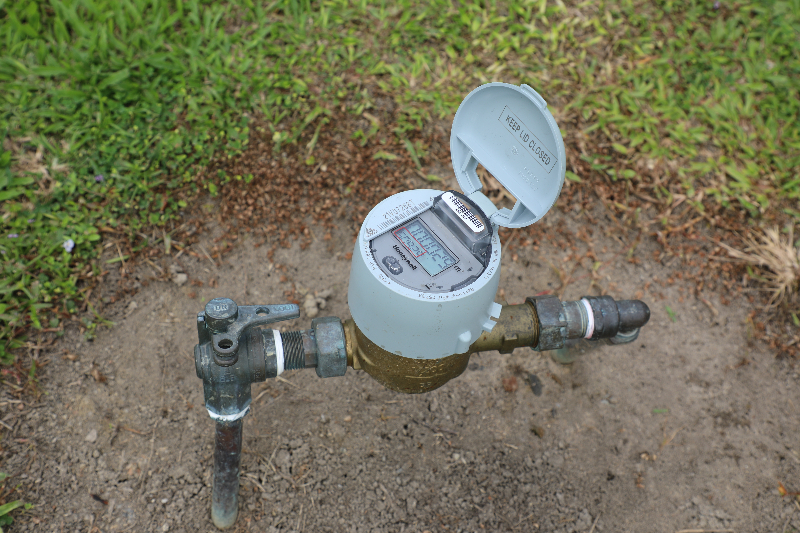
Have a leak repaired quickly!
You may be responsible for all the water that goes through your meter.